

If you are comparing stroller wagons, safety certification deserves more attention than a catchy feature list. A JPMA certified stroller wagon has been evaluated through the Juvenile Products Manufacturers Association certification program against applicable stroller safety requirements. That does not make any product accident-proof, but it gives parents a useful starting point for comparing designs, documentation, and everyday safety features.
Explore JPMA-certified Keenz stroller wagons to compare models built for different family sizes and routines.
What does JPMA certification mean for a stroller wagon?
JPMA certification identifies a stroller wagon that participates in a certification program based on applicable safety standards for carriages and strollers. In the United States, that framework includes the federal standard in 16 CFR Part 1227, which incorporates ASTM F833. Certification is one trust signal, but parents should still follow the product manual and use the wagon as directed.
In practical terms, JPMA certification helps answer a focused question: has this product been evaluated against recognized stroller safety requirements? It is different from a brand simply saying that a wagon is sturdy, premium, or family-friendly. When a listing uses the certification claim, look for the exact model, current product documentation, and clear information about the wagon's intended age, height, weight, and passenger limits.
The certification mark also should not be confused with a blanket promise about every product a company has ever made. Stroller wagons can change by model year, passenger capacity, frame design, or intended use. Confirm the claim for the specific wagon you are considering.
How are JPMA, ASTM, and CPSC safety standards related?
JPMA is the certification program parents may see associated with a juvenile product. ASTM develops consensus standards that describe performance, test methods, and labeling expectations. The U.S. Consumer Product Safety Commission enforces federal consumer-product requirements, including the federal stroller standard that incorporates the applicable ASTM standard. The three names describe related but different parts of the safety landscape.
| Term | What it represents | Why parents should care |
|---|---|---|
| JPMA certification | A certification program for qualifying juvenile products | Provides an additional product-level signal to investigate when comparing wagons |
| ASTM F833 | A consumer safety performance specification for carriages and strollers | Describes safety performance, test methods, and labeling requirements |
| 16 CFR Part 1227 | The U.S. federal safety standard for carriages and strollers | Sets the legal framework that incorporates the applicable ASTM standard |
| CPSC | The federal agency responsible for consumer-product safety oversight | Publishes guidance and administers requirements, recalls, and enforcement |
For primary references, review the CPSC guidance for carriages and strollers, the current text of 16 CFR Part 1227, and the ASTM F833 standard listing. These sources explain the standards themselves. They do not replace the instructions supplied with your stroller wagon.
What should you look for in a JPMA certification claim?
A useful certification claim should identify the product clearly enough for you to verify it. Treat vague wording such as "safety tested" or "meets high standards" as an invitation to ask follow-up questions, not as a substitute for model-specific information. The strongest starting point is a named stroller wagon with accessible documentation and a manufacturer that can explain its intended use.
- Exact model name: Make sure the certification reference matches the wagon's model name and passenger configuration.
- Current documentation: Look for a product page, manual, support article, or packaging reference that you can save for later.
- Recognized standards: Check whether the claim explains the relevant stroller standards rather than using certification as an unexplained marketing badge.
- Clear limits: Confirm the age, height, weight, passenger, and accessory guidance before you compare comfort or storage features.
- Manufacturer support: Choose a brand that gives parents a way to ask model-specific questions and find replacement or care information.
Certification is most useful when it is part of a transparent information trail. If a marketplace listing makes a claim that the manufacturer's own page does not support, pause and verify the discrepancy before buying.
Are all stroller wagons JPMA certified?
No. JPMA certification is not automatic for every stroller wagon, and a brand name alone does not prove that every model carries the same certification. Certification can vary by product, model, and certification period. Parents should check the exact product page, packaging, manual, or manufacturer support documentation before treating a wagon as JPMA certified.
Keenz has made certification a central part of its stroller wagon line. Keenz describes its 7S as the first JPMA-certified stroller wagon in North America, and its support library documents JPMA certification for models including the XC, XC+, DUO, Vyo4, and 7S+. For the current model you are considering, verify the product-specific information rather than relying only on an older review or a marketplace listing.
This model-level check matters for families shopping across passenger capacities. A two-passenger wagon may have different seats, harnesses, dimensions, and use limits than a four-passenger wagon. If a product page or manual is unclear, contact the manufacturer before buying and ask which exact model is covered.
Related products

Restore the smooth mobility of your Keenz 7S+ stroller wagon with the Keenz 7S+ Replacement Axle.
View product
Spacious 4-passenger stroller wagon for family outings
View product
Comfortable 2-passenger stroller wagon for everyday adventures
View productWhich stroller wagon safety features should parents check?
A certification label is an important starting point, but the day-to-day safety of a stroller wagon depends on the design and on how the adult uses it. Before buying, inspect the restraint system, brake, frame, fold, wheels, storage layout, and labels. Then ask whether those features fit your children's ages, sizes, and typical destinations.
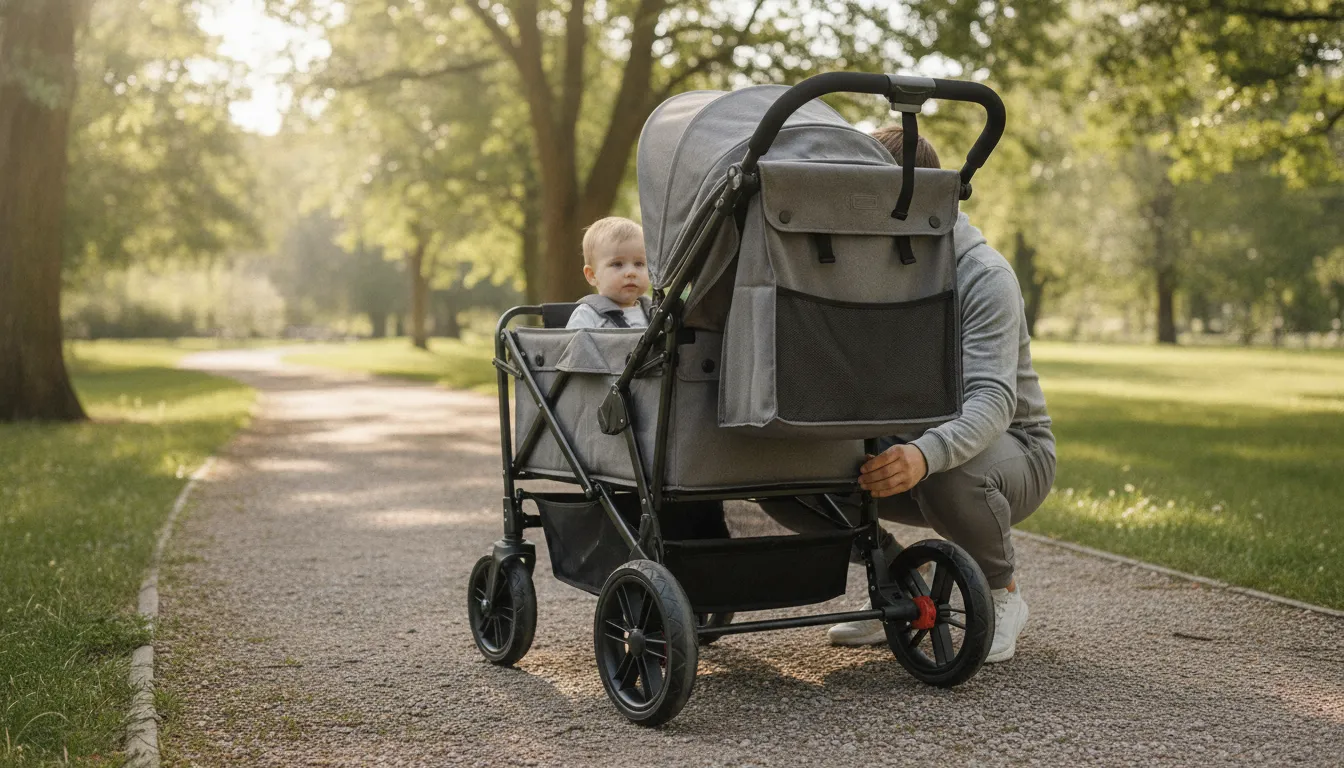
1. A properly adjustable harness
Look for a restraint system that fits the child using the wagon, adjusts securely, and is easy for the supervising adult to buckle correctly. A five-point harness is designed to secure the shoulders and hips, but the number of points alone is not a substitute for correct adjustment. Use every restraint as directed, and buckle children even during short trips.
2. A reliable parking brake
The brake should engage fully and remain engaged when the wagon is stopped. Check that the adult can reach and operate it without awkwardly leaning over the children. JPMA's parent safety guidance recommends applying stroller brakes whenever stopped and avoiding slopes. Make that part of your routine before you load bags, help a child in or out, or pause for a snack.
3. A stable frame and sensible load placement
Compare the wagon's passenger, seat, and storage limits with your real routine. Keep heavy bags in the intended storage basket instead of hanging them from the handlebar. Hanging weight high on the handle can change the balance and increase tip-over risk. Follow the manufacturer's limits for passengers, cargo, and accessories.
4. A controlled fold and unfold
Folding mechanisms should latch when the wagon is open and remain clear of small hands during setup. Read the instructions before the first outing, identify pinch points, and keep children away while you unfold or collapse the frame. Never use a wagon that does not open fully, lock correctly, or move as described in the manual.
5. Wheels and steering suited to the route
All-terrain wheels can improve comfort and control on grass or packed paths, but no wheel design makes every surface equally easy. Think about sidewalks, gravel, ramps, trails, and storage areas you will actually use. Check the wheels for secure attachment, make sure they roll as intended, and avoid routes or loads outside the manufacturer's guidance.
6. Clear labels and accessible instructions
Age, height, weight, passenger, and warning information should be easy to find. Keep the manual available for caregivers, and register the product if the manufacturer provides a registration process. Instructions matter after purchase because safe use includes knowing when a child has outgrown a seat, when an accessory is compatible, and how to inspect the wagon.
What does JPMA certification not tell you?
JPMA certification does not tell you that a stroller wagon can be used on every surface, with every accessory, or by every child. It does not remove the need for an adult to supervise, engage the brake, use the harness, observe weight limits, or inspect the wagon. Certification supports a buying decision; it does not replace responsible operation.
- It does not replace the manual. The manufacturer's instructions remain the source for the model's use limits, setup, care, and compatible accessories.
- It does not guarantee a perfect fit. A certified wagon may still be too large for your vehicle, too heavy for your storage space, or poorly matched to your route.
- It does not make unsafe habits safe. Do not overload the handle, leave the brake off while stopped, or allow a child to ride outside the designated seating area.
- It does not eliminate maintenance. Inspect harnesses, wheels, brakes, fasteners, and folding points according to the product instructions.
- It does not replace active supervision. Stay close, especially around curbs, stairs, water, traffic, and uneven ground.
JPMA's own parent stroller safety guidance emphasizes buckling children, preventing tip-overs, using brakes, keeping hands clear during folding, and following manufacturer labels. Those habits apply whether a family chooses a stroller, a stroller wagon, or another wheeled juvenile product.
Use Keenz's stroller wagon comparison chart to compare passenger capacity and safety-related features before you choose a model.
What should you do before a child's first ride?
Even a well-documented, JPMA-certified stroller wagon needs a careful setup before the first outing. Use the assembly and care instructions as your checklist. A first-ride inspection is especially important after shipping, storage, or any repair because a loose component or incorrect fold can change how the wagon behaves.
- Inspect the frame: Check that the frame is fully open, the locking points are engaged, and no fabric or accessory is caught in the mechanism.
- Check the wheels: Confirm that each wheel is attached, rotates as expected, and is not rubbing against the frame.
- Test the brake: Engage the parking brake on a level surface and gently test whether the wagon stays in place before placing a child inside.
- Adjust the harness: Fit each restraint to the child according to the manual. Buckles should close correctly, and straps should not be twisted.
- Secure accessories: Use only compatible accessories and place cargo in the areas identified by the manufacturer.
- Review the route: Start somewhere familiar and level so you can learn the steering, turning radius, stopping distance, and fold before a longer trip.
Repeat this inspection whenever the wagon has been folded, transported, repaired, or used in unusually rough conditions. If a component does not work as described, stop using the wagon until the manufacturer or an authorized service source provides guidance.
How can you evaluate a JPMA-certified stroller wagon before buying?
Use a repeatable process instead of choosing based on one badge or one feature. Start with the exact model, then compare its documentation, fit, and everyday controls with your family's needs. A few minutes of structured checking can reveal whether a certified stroller wagon is a sensible match for your children and your routine.
- Confirm the exact model. Record the model name, passenger capacity, and model year shown on the product page or packaging.
- Verify the certification claim. Look for manufacturer documentation or support information that names the exact wagon, not only the company.
- Read the use limits. Check age, height, weight, seating, passenger, and accessory guidance before comparing comfort features.
- Test the controls. If possible, operate the harness, brake, handle, fold latch, and wheels before purchase or immediately after delivery.
- Plan the route. Match wheel size, steering, clearance, and storage to the sidewalks, grass, paths, and vehicle you use most.
- Review the care plan. Know which parts require inspection, cleaning, tightening, or replacement, and keep the instructions available.
- Teach every caregiver. Make sure grandparents, sitters, and other adults know how to buckle the child, use the brake, and fold the wagon safely.
For a broader overview of how stroller wagons differ by passenger count and use case, read Keenz's guide to what a stroller wagon is. This safety guide focuses on certification and use checks, while the broader article covers category basics.
Why do families consider Keenz for a certified stroller wagon?
Keenz built its brand around combining stroller functionality with wagon capacity, and certification is part of that safety-focused positioning. Current Keenz materials describe JPMA-certified options across the lineup, with choices for families seeking two- or four-passenger configurations, reclining comfort, storage, and outdoor flexibility. The right model still depends on your children's size, your route, and your vehicle.
Families can compare the current two-passenger stroller wagons and four-passenger stroller wagons by capacity and features. The Keenz MOOV collection highlights all-terrain comfort and reclining seating, while the Keenz VIVA collection is positioned for a more compact ride. Review the exact product page and manual for the model you choose.
Keenz also provides a stroller wagon comparison chart for shoppers who want to compare configurations. Use it alongside certification information, not instead of the product-specific safety instructions.
Compare Keenz stroller wagons and narrow your options by passenger capacity, terrain, fold, and the safety features your family will use every day.
Frequently asked questions about JPMA-certified stroller wagons
What is the difference between a JPMA-certified stroller wagon and a regular wagon?
A JPMA-certified stroller wagon participates in a certification program tied to applicable stroller safety standards, while a regular utility wagon may not be designed or evaluated for carrying children. Parents should confirm the product's intended use, restraints, brakes, labels, and model-specific documentation before allowing a child to ride.
Is a JPMA-certified stroller wagon safer than an uncertified wagon?
Certification gives parents an additional product-level safety signal, but it is not a guarantee of safe use or a ranking of every wagon. Compare the exact model, safety documentation, harness, brake, stability, limits, and fit. Then follow the manual and supervise children whenever the wagon is in use.
Does JPMA certification mean a stroller wagon is approved for a child of any age?
No. JPMA certification does not override the manufacturer's age, height, weight, or developmental recommendations. Use a wagon only within the limits listed for that model. If your child is between stages or you are unsure whether the seating position is appropriate, ask the manufacturer before use.
Do stroller wagons need five-point harnesses?
Families should use the restraint system supplied with the wagon exactly as instructed. Many stroller wagons, including current Keenz models, use five-point harnesses, but the correct fit and consistent use matter as much as the harness design. Never add an unapproved restraint or alter the supplied system.
Can I use a JPMA-certified stroller wagon on a hill?
Do not park a stroller wagon on a slope unless the manufacturer's instructions specifically address that situation and provide safe guidance. JPMA parent safety guidance recommends applying the brake whenever stopped and avoiding slopes. Keep one hand on the wagon while positioning it and choose a level stopping place whenever possible.
Where can I verify whether a specific Keenz wagon is JPMA certified?
Start with the exact Keenz product page, product documentation, or Keenz support article for the model. Keenz support pages document certification for several models, including XC, XC+, DUO, Vyo4, and 7S+. Because products and model years can change, verify the current model rather than relying on a reseller description or an old review.
The bottom line on JPMA-certified stroller wagons
A JPMA-certified stroller wagon can give parents a stronger starting point when comparing child-carrying wagons, but the certification is only one part of a safe purchase. Confirm the exact model, understand how JPMA relates to ASTM and federal requirements, review the manual, and evaluate the harness, brake, stability, fold, wheels, storage, and use limits. The safest wagon is one that fits both the product guidance and your family's real routine.
For additional model questions, review the Keenz FAQ library and the product documentation for the wagon you are considering.