

Understanding stroller wagon age and weight limits helps you choose a ride that fits your child today and still works as your family changes. For broader context on how stroller wagons work and which families they suit, start with this complete stroller wagon guide. Then check the model's minimum age, each passenger's limit, the wagon's total capacity, the harness fit, and the configuration you plan to use.
Explore Keenz stroller wagons to compare 2-, 4-, and 6-passenger options for your family's routine.
What age can a child start using a stroller wagon?
Many current Keenz stroller wagons list a recommended starting age of 6+ months. The Keenz DUO has a different minimum for its base configuration: 12+ months, or 6+ months when used with compatible XC+ seats. Always follow the age recommendation and seating instructions for your exact model, because a child must fit the seat and harness, not merely fall under the weight limit.
The 6-month starting point on many Keenz models
The Keenz comparison chart lists 6+ months for the VIVA and MOOV models. That is a starting point, not a substitute for checking whether your child is ready for the way the seat is used. Before a ride, confirm that your child can sit in the intended position, that the 5-point harness can be adjusted snugly, and that the canopy, tray, and other components are installed as directed.
- Use the minimum age printed for your exact wagon and generation.
- Keep your child secured with the harness whenever the wagon is moving.
- Check that the harness sits correctly on your child and is not loose or twisted.
- Do not place an infant in a configuration that the manual does not approve.
- Read the manual again when you add seats, adapters, or other accessories.
What if you need an infant car seat setup?
A stroller wagon's seat age recommendation does not automatically mean the wagon accepts a newborn or an infant car seat. If you want to use an infant car seat, confirm that your wagon model and the specific adapter are listed as compatible. Keenz offers a car seat adapter collection for selected models, including XC, DUO, and VYOO configurations. Follow both the wagon instructions and the car seat manufacturer's instructions, and never improvise an attachment.
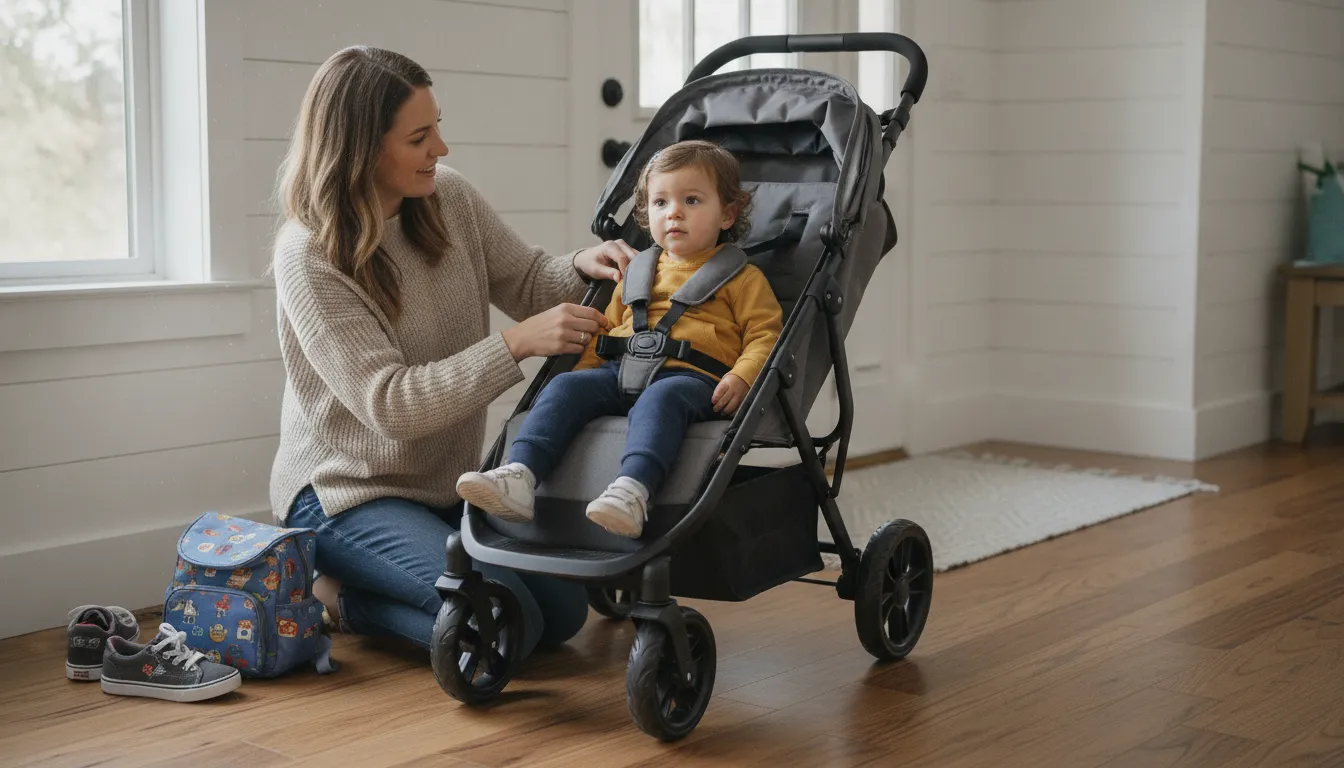
What are the maximum weight limits by stroller wagon model?
Keenz publishes both a total wagon weight limit and passenger limits, and those figures answer different questions. A total capacity is not permission to place that much weight in one seat. Use the lowest applicable limit for the child, the seat, the cargo area, and the complete wagon configuration. The exact manual and product label control if a number differs by model generation.
| Keenz model or group | Starting age | Published total wagon limit | Passenger guidance |
|---|---|---|---|
| VIVA 2 and MOOV 2 | 6+ months | 216 lb | Up to 55 lb per passenger on the current comparison chart |
| VIVA 4 and MOOV 4 | 6+ months | 326 lb | Up to 55 lb per passenger on the current comparison chart |
| Current VYOO 2 | Check the model manual | 216 lb | Use the passenger and configuration limits in the manual |
| Current VYOO 4 | Check the model manual | 326 lb | Use the passenger and configuration limits in the manual |
| XC EVO 2 and XC+ EVO 4 | Check the model manual | 216 lb or 326 lb, respectively | Use the exact seat and configuration limits |
| XC6 EVO | Check the model manual | 501.6 lb | 83.6 lb per seat as listed in Keenz product information |
| DUO | 12+ months in the base setup; 6+ months with compatible XC+ seats | 326 lb | Configuration-dependent; use the applicable seat limit |
These figures are useful for comparing models, but they should not be combined casually. For example, the comparison chart lists up to 55 lb per passenger for the VIVA and MOOV models while also showing a higher total wagon limit. In practice, the passenger limit, cargo limit, and instructions for the specific model all still apply. If you own a legacy 7S, 7S 2.0, or 7S+ wagon, use that model's documentation instead of assuming the current VIVA or MOOV numbers apply.
See the Keenz comparison chart for current model specifications and feature differences.
How do you use a stroller wagon from infant to big kid?
A stroller wagon can serve different jobs as a child grows, but the safe setup changes with the child's size and the model's instructions. Start with the approved configuration for a younger rider, then reassess the harness, seat depth, footwell, canopy, and available space as your child gets taller and heavier. A wagon that still rolls well may no longer fit a growing child comfortably.
Infants and younger riders
For a child below the wagon's seat minimum, do not use the regular seat simply because there is room. Check whether your model supports a compatible infant car seat adapter and whether the adapter is approved for that model. The Keenz FAQs and your product manual are better sources for configuration questions than a general age range found in a product review.
Toddlers and preschoolers
This is the stage when many families use a wagon most often. A toddler may fit well within the passenger limit but still need the harness adjusted as clothing, posture, and height change. Keep the brake engaged when loading or unloading, use the harness, and keep heavy bags in the intended storage area rather than on the seat or canopy.
Big kids
There is no single upper age that applies to every stroller wagon. Continue using a wagon only while the child fits the seat, can be secured correctly, remains within the passenger and total limits, and can ride comfortably without interfering with the other passenger. Height, shoulder position, legroom, and the ability to sit within the wagon's boundaries matter alongside body weight.
Can two children of different ages share a stroller wagon?
Yes, siblings of different ages may share a multi-passenger stroller wagon when the younger child meets the minimum age for the exact configuration and both children fit their own seats. Check each passenger's limit separately, keep each child secured, and make sure the combined passengers and cargo stay within the wagon's total limit. The older child's extra space cannot compensate for an age-inappropriate setup for the younger child.
- Confirm that the younger child meets the model's minimum age and seating requirements.
- Check each child's fit independently, including harness position, shoulder height, and foot space.
- Place one child in each intended seating position instead of letting one child sit on a tray, storage area, or another unapproved surface.
- Balance bags and accessories in the designated storage areas.
- Test the brake and push or pull the wagon slowly before starting a longer outing.
Families comparing two- and four-passenger options can start with the 2-passenger stroller wagon collection or the 4-passenger stroller wagon collection, then verify the exact product specifications before ordering.

When should you stop using a stroller wagon?
Stop using a stroller wagon when your child reaches the applicable weight or height limit, no longer fits the harness or seating area, cannot sit safely in the intended position, or the exact manual says the configuration should no longer be used. Do not wait for a visible problem during an outing. Recheck fit at home, especially before a long walk, trip, or event.
- Weight: The child is at or above the passenger limit, even if the wagon's overall capacity appears higher.
- Height: The child's shoulders, head, or legs no longer fit the seat and harness area as intended.
- Harness: The harness cannot be adjusted snugly and correctly.
- Comfort: The child is cramped, cannot sit back against the seat, or repeatedly interferes with another passenger.
- Configuration: A seat, adapter, accessory, or cargo arrangement changes the limits in the manual.
- Condition: The frame, wheels, brake, harness, or fold mechanism is damaged or does not work as intended.
When a child has outgrown one seat but a younger sibling still rides, consider whether the remaining rider can use the wagon alone within the manual's limits. Do not keep an older child in the wagon just to fill a seat or assume that an empty seat makes an unsafe fit acceptable.
How should parents choose a stroller wagon using age and weight limits?
The best match is the model that fits your real passenger combination, not simply the wagon with the highest number. Use this short checklist before comparing features:
- Start with today's youngest rider. Confirm the minimum age and whether the approved setup uses a regular seat, compatible seat, or infant car seat adapter.
- Estimate each child's growth. Look at passenger limits, height and foot space, and how much headroom remains for the next season.
- Separate child weight from cargo. Diaper bags, coolers, toys, and accessories count toward the applicable storage or total limit.
- Choose the passenger count. A 2-passenger wagon may be easier to store, while a 4- or 6-passenger model may make sense for more children or shared outings.
- Check the terrain and routine. Wheels, recline, storage, fold dimensions, and suspension can matter as much as capacity for parks, travel, or everyday errands.
- Save the manual. Product generations can have different limits. Keep the manual for the wagon you own, not a similar-looking model.
Read the complete stroller wagon guide for broader help choosing the right style, capacity, and features, then return to the age and weight limits for your final fit check.
Stroller wagon age and weight limit FAQs
What is the best age to start using a stroller wagon?
Many current Keenz VIVA and MOOV models list a recommended age of 6+ months. The correct starting point depends on the exact model and configuration. Check the product manual, confirm the child fits the seat and harness, and use an approved infant setup when applicable.
How much weight can a Keenz stroller wagon hold?
Keenz limits vary by model. Current 2-passenger VIVA and MOOV models list a 216 lb total wagon limit, while current 4-passenger VIVA and MOOV models list 326 lb. Passenger limits are separate, so use the lower applicable child, seat, cargo, or configuration limit.
Can a baby ride in a stroller wagon?
Only when the exact wagon and approved configuration allow it. A regular stroller wagon seat is not automatically suitable for a baby. Check for a compatible infant car seat adapter and follow the wagon and car seat instructions without modifying the attachment.
Can a stroller wagon be used for an older child?
There is no universal upper age limit. An older child may continue to ride while the child remains within the model's weight and height limits, fits the harness and seat, and can sit safely. The manual for the exact model controls.
Can siblings with different weights share one stroller wagon?
They can when both children meet the model's age and fit requirements. Check each passenger's limit separately, secure both harnesses, and keep all passengers and cargo within the wagon's total capacity. Never use a storage space, tray, or unapproved surface as an extra seat.
Where can I verify my Keenz wagon's exact limits?
Start with the label and manual for your wagon, then compare the information with the Keenz comparison chart and Keenz FAQs. Legacy models can have different limits from current models, so use the documentation for the model and generation you own.